Object Record
Images
Metadata
Object Name |
Cutter, Cabbage |
Catalog Number |
2008.019.01 |
Description |
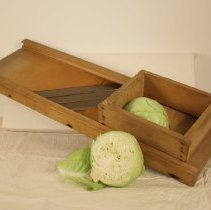
Wooden kraut/cabbage cutter with three metal blades in the center. There are grooves on right and left sides for the box, which slides into the grooves. Printed on the top back is "645-W. KRAUT CUTTER. T&D MFG. CO.. INDPLS., IND." T&D stands for Tucker and Dorsey. |
Year Range from |
1905 |
Year Range to |
1920 |
Provenance |
Donor's note on deed of gift states: "This belonged to my mother-in-law. Mary Jirocek Schnell. She got it from her mother, Barbara Martinek Jiracek. Last time it was used was the fall of 1972." |
Used By |
Mary Jiracek Schnell and Barbara Martinek Jiracek |
Material |
Metal/Wood |
Dimensions |
H-2 L-33 D-10.75 inches |
Length (in) |
33.000 |
Height (in) |
2.000 |
Dimension Details |
Measurements listed above were measurements of the frames, depth was distance from one end of a frame to the other frame's end. Interior base measurements are Length 32.80 inches, depth 8.5 inches, height 0.80 inches |
People |
Schnell, Mary Jiracek Jiracek, Barbara Marinek |
Subjects |
"Things that Matter" Food |
Search Terms |
"Things that Matter" |
Notes |
Featured in Things that Matter "The only thing better than daydreaming about the spring garden is daydreaming about the first fresh-from-the-earth harvest. You determined souls who start your own seeds may be getting ready to sprout cold-weather crops like cabbage. If, down the road, you find yourself with more cabbage than you know what to do with, grab one of these handy "cabbage cutters" and make a huge batch of sauerkraut to be stored and savored throughout the year. This is what the Bohemian and German immigrants to this area did to preserve their harvest, just as they had in the old country. The three metal blades on the cabbage or "kraut" cutter from the La Crosse County Historical Society’s collection would make quick work of a full head of cabbage. This particular cutter, made by Tucker and Dorsey Manufacturing Co. in Indianapolis, included a small wooden box that slid up and down over the blades. The enterprising home cook would put a cabbage head in the box and run the box repeatedly over the blades until the cabbage had been reduced to shreds. The cook would then layer the cabbage with salt in a huge crock, and weigh the whole thing down with a heavy object. (If you’ve ever found an enormous lake stone in your grandparents’ basement, this might be why.) After that, it’s only a matter of waiting for the cabbage and salt to ferment into that tangy slaw we all love to eat with our Oktoberfest brats. The donor of this cabbage cutter, Marian Schnell, wrote on her donation form: "This belonged to my mother-in-law, Mary Jirocek Schnell. She got it from her mother, Barbara Martinek Jiracek. Last time it was used was the fall of 1972." This article was originally published in the La Crosse Tribune. Title: Cabbage Cutter Author: Caroline Morris Publish Date: March 21, 2015 |