Object Record
Images

Metadata
Object Name |
Hammer, Marking |
Catalog Number |
2020.fic.010 |
Description |
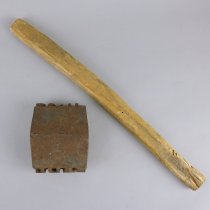
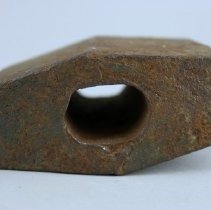
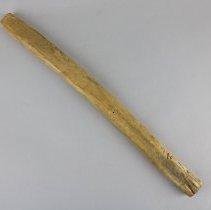
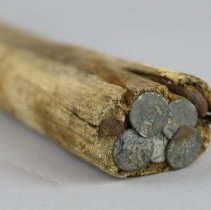
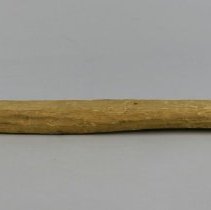
Iron brand for lumber company identification and wooden handle. Brand is rectangular, but widest in the center and slopes slightly down from the center to each face. Faces both read "PAUL" for the John Paul Lumber Company. Hole through the middle for a handle. Handle is made of light-colored wood and slightly curved. One end of the handle has six nails and a large staple driven into it. |
Year Range from |
1861 |
Year Range to |
1914 |
Material |
iron, wood |
Dimensions |
H-2 W-4 L-5 inches |
Length (in) |
5.000 |
Height (in) |
2.000 |
Width (in) |
4.000 |
Dimension Details |
Dimensions are for iron brand. Dimensions of handle are: 19in long, 1.5in wide, 1in deep. |
People |
Paul, John |
Subjects |
Businesses "Things that Matter" |
Search Terms |
John Paul Lumber Company "Things that Matter" |
Notes |
Featured in Things that Matter: This iron-marking hammer belonged to the John Paul Lumber Co. It is a reminder of the once-booming lumber and sawmill industry in La Crosse in the late 19th century. John Paul, who built his first sawmill in 1860, was one of a dozen sawmill owners who took advantage of La Crosse’s location along the Mississippi and at the mouth of the Black River. John Paul owned one of the most prominent of the La Crosse lumber companies, simply named the John Paul Lumber Co. Logs that passed through his sawmill were each marked with a stamp like this one, which reads "PAUL" on either end. As lumberjacks felled trees, they impressed the end of the log with a hammer with the company mark. Although the John Paul Lumber Co.’s mark was the owner’s name, other companies’ marks could be initials, numbers or shapes. These marks came in handy when logs were sent down the Chippewa, Black or St. Croix rivers and mixed with those from other companies. At natural or artificial stopping points, lumbermen called boom tenders sorted logs by owner to get each one to the correct sawmill. Tens of thousands of logs were marked with the symbol for the John Paul Lumber Co. This sawmill was the largest on the Mississippi River by 1880. In its first year, it produced 800,000 board feet of lumber. Production peaked in 1892 with 43 million board feet of lumber — enough to build about 26,000 houses. The John Paul Lumber Co, owned two lumberyards in La Crosse: one at the saw mill along Front Street between Cass and King streets, and one at the eastern outskirts of town. The company also ran several other lumberyards across southern Minnesota and the Dakota Territory, supplying the growing frontier with John Paul lumber. About one-third of the lumber was sent down the Mississippi to markets in the south. The lumber industry was entirely dependent on a resource that was being quickly depleted. Even in the 1870s, some areas of Wisconsin’s pine forests were becoming sparse. By 1899, the John Paul Lumber Co.’s sawmill produced only 8 million board feet, and shortly closed production. Understanding the poor prospects of the Wisconsin logging industry, John Paul shifted his attention to his other company, the East Coast Lumber Co., based in Florida. This article was originally published in the La Crosse Tribune. Title: John Paul Lumber Co. Author: Kimberly Thompson Publish Date: February 21, 2020 |