Object Record
Images
Metadata
Object Name |
Cooler, Water |
Catalog Number |
1961.006.01 |
Description |
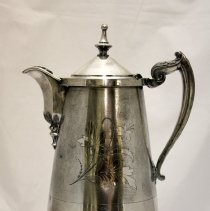
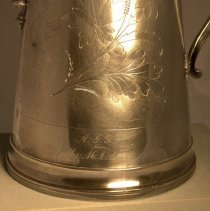
Large silver pitcher or water cooler. Possibly German Silver. Hinged lid with finial, spout and handle. Etched floral design on each side, and inscription along bottom that reads: "A.G.L. from M. & M. D.G." Stamped disk on bottom says "Rogers Smith & Co, New Haven Ct, Pat'd. June 13 1868. Body is lined with glass, which was done through the bottom somehow, with a silver plug with printing (not legible) in the bottom. |
Other Name |
Pitcher |
Year Range from |
1868 |
Year Range to |
1875 |
Provenance |
The donor stated that she "owned the pitcher for at least 40 years," and that she "got it from Rose Waters, who operated a beauty shop in the Linker Bldg." |
Dimensions |
H-14 W-0.001 L-0.5 inches |
Length (in) |
0.500 |
Height (in) |
14.000 |
Inscription Type |
Inscription |
Inscription Text |
A.G. from M. & M.D.G. |
Inscription Location |
Bottom of front |
People |
Levy, Fredericka Augusta |
Subjects |
"Things that Matter" Domestic Furnishings |
Search Terms |
"Things that Matter" |
Notes |
Featured in Things that Matter "This large glass-insulated, silver-plated water pitcher, with its 1865 patent date, is said to have belonged to Fredericka and John Levy. It makes a very appropriate symbol for a couple whose home became synonymous with hospitality in the tiny settlement that was La Crosse when they arrived in 1846. Their one and a half story log cabin was in fact only the fifth settler’s home on Prairie La Crosse. The store/trading post in the Levy home consisted of one large room. This room, with its welcoming hosts and large fire place, became a center of social life for the region. Travelers stayed with the Levys, bringing news and goods to trade. Traders, loggers, Native Americans, green settlers from the east and from abroad--all found their way to the Levy home. The Levys had arrived just before the tiny outpost had begun a period of rapid growth, as the federally-mandated Indian Removals opened up land for settlers. When these began to affect the Ho Chunk in the Coulee Region, a contingent came to John Levy and asked him to intervene and write a letter on their behalf to President Polk, asking him to rescind the order for forced removal. Levy, who had built relations with the tribes and saw them as valuable customers, obliged, but with no success. For the next several decades the Levys’ businesses thrived. John Levy gained a reputation as a thoughtful, energetic, and honest community member, and he served as mayor three times. They built a larger house, and in 1856, after ten years of putting up visitors in their home, opened the Augusta Hotel, with 100 rooms. John Levy was born in 1820, in London, to German-Jewish parents. He was educated on "the continent," in Paris and Amsterdam. He came to America at the age of seventeen and went into the fur business in St. Louis, eventually moving up river, first to Prairie du Chien, and then to La Crosse, bringing his wife and child with him. As an active community supporter, several of the first church services, both Christian and Jewish, were held in the Levy home. Other Jewish settlers followed him, victims of the German Revolutions of 1848-49. They formed a Hebrew benevolent society, and became community leaders with important civic positions." This article was originally published in the La Crosse Tribune. Title: Frontier Hospitality Author: Peggy Derrick Publish Date: June 18, 2016 |