Object Record
Images
Metadata
Object Name |
Uniform, Military |
Catalog Number |
1986.067.01 |
Description |
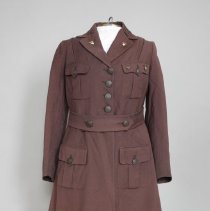
WWI U.S. Army Nurse Corps wool uniform coat. Part of two piece uniform paired with skirt, (1986.067.15). Originally blue but faded to dark brown/purple color. Long coat with belt and buttons on belt. Two breast pockets and two hip pockets. All pockets have flaps and buttons. Lined with black silk and weighted in front corners of lining. Pins on either side of collar read "U.S." and "ANC" over medical emblem, respectively. Other pins on left breast pocket, including double chevron. Label on inside of collar reads "MADE IN USA, WELTMAN, POLLACK & CO., NEW YORK". 15" shoulder, 30" long. |
Other Name |
Coat |
Provenance |
According to textile catalog card, this uniform was worn by Mabel Malia Bettin. "This uniform is rare. It is the style worn between 1901 and the end of the First World War. Only 20 such uniforms were in existence in 1909, and 150 by the war's end." In addition, according to the textile catalog card, she was "injured twice in battle according to an analysis of medals". |
Used By |
Mabel Malia Bettin |
Owned By |
Mabel Malia Bettin |
Date |
1918 |
Event |
World War I |
Dimensions |
W-15 L-30 inches |
Length (in) |
30.000 |
Width (in) |
15.000 |
People |
Bettin, Mabel Malia |
Subjects |
"Things that Matter" Clothing & Accessories Health & Medicine Military |
Search Terms |
WWI World War I "Things that Matter" |
Relation |
Show Related Records... |
Notes |
Featured in Things that Matter "In Nov. 1918, Sgt. Chandler W. Post penned an ode to "The Army Nurse," published in The Stars and Stripes. "She comes with a cheery ‘Good morning,’/Then a word to the fellow who’s blue;/ And, really now, it’s amazing/ What her pleasant smile will do." Post had spent three months in five different hospitals, so was a bit of an expert on the nurses in the U.S. Army Nurse Corps.[1] Though thousands of women served as nurses in WWI, inconsistent record-keeping and a decades-long ambivalence about their status as veterans has obscured details of their service. Mabel Malia, a 25-year-old nurse from Galesville, was one of the thousands of women who volunteered for service in what was then called "The Great War." She had graduated from the Lutheran Hospital Nursing School in 1916, and continued to work at Lutheran Hospital until her enlistment in the U.S. Army on June 5, 1918. This wool jacket and skirt set was likely her uniform for traveling and official duties; she would have worn a simpler cotton dress for actual work. We know only the barest essentials of Malia’s wartime experience. She was in the Nurse Corps for nearly fourteen months, including more than eight months after the Armistice on Nov. 11, 1918. The horrors of prolonged trench warfare did not end with the Armistice, and Malia undoubtedly did some of her most difficult work after the guns had stopped, as she and roughly 20,000 other nurses tried to repair the damage to men’s bodies and minds. After the war, Malia worked at a hospital in Iowa, but ultimately returned to La Crosse. She married George T. Bettin, a fellow veteran and a La Crosse native, in the early 1920s. Bettin’s and Malia’s families lived near each other on Badger St. in 1917 when war broke out, so the two may have known each other prior to enlistment. George Bettin was one of the first eleven men from La Crosse to volunteer for the "New Army" in the summer of 1917, though we know little about his service as well. It is likely that both of their personnel files were destroyed in a 1973 fire at the National Personnel Records Center. Mabel Malia Bettin and George Bettin built a life together in La Crosse, raising three children and playing active roles in the community. One wonders if they discussed their wartime experiences, or if they followed prevalent advice of the time to forget it. This Veterans Day, the La Crosse County Historical Society urges you to take a moment to remember – and certainly not to forget – the contributions of everyday Americans like the Bettins." [1] The Stars and Stripes (Paris, France: Nov. 29, 1918, vol. 1, no. 43, p.4. This article was originally published in the La Crosse Tribune. Title: Mabel Malia Goes to War Author: Caroline C. Morris Publish Date: November 17, 2015 |